
How Flexible Financing Removes Barriers in Home Improvement Projects
Published: February 17, 2026
Read time: 5 minutes
Author: Tim Musch, Business Development Specialist
Financing options are the determining factor for 74% of homeowners when hiring a contractor.1 Not price. Not product. Financing options.
This staggering number suggests that how you present payment options matters more than the actual cost of the project. For many contractors, this is an untapped opportunity.
Why Financing Is a Major Barrier for Homeowners
Upfront costs for a home improvements can be the reason customers delay or cancel projects. A window replacement can cost $20,000. A roof replacement can be $30,000+. A kitchen remodel can exceed $50,000.
Customers know they need to hire for the project but what’s stopping them from moving forward is feeling comfortable with how they will pay for the updates.
A contractor who introduces home improvement financing as an option for homeowners takes the pressure off of the entire estimate process and is more likely to close the deal.
The difference is presentation. The difference is choice.
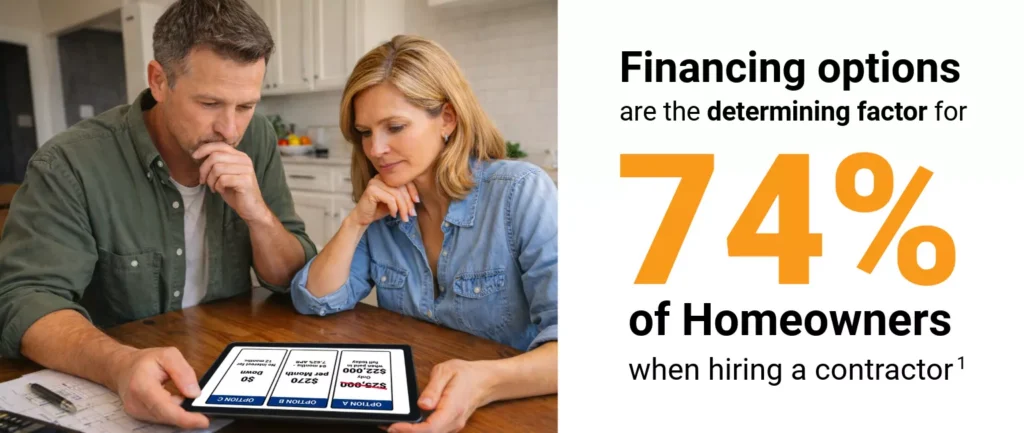
How Homeowners Think About Home Improvement Financing
Sticker shock and budget anxiety can kill a deal before homeowners even have a chance to think about what’s being offered.
Overcoming price objections doesn’t have to mean lowering the price. When presented with a range of payment options, a customer can see the value over the price.
The Hidden Cost of Rigid Payment Structures
The key to closing deals is how you present the price.
When a homeowner sees a rigid price point of “$25,000”, their brain does a few things:
- It compares it to other quotes (which may be apples-to-oranges comparisons)
- It judges whether they “can afford” the full amount
- It introduces doubt and can push customers towards competitors
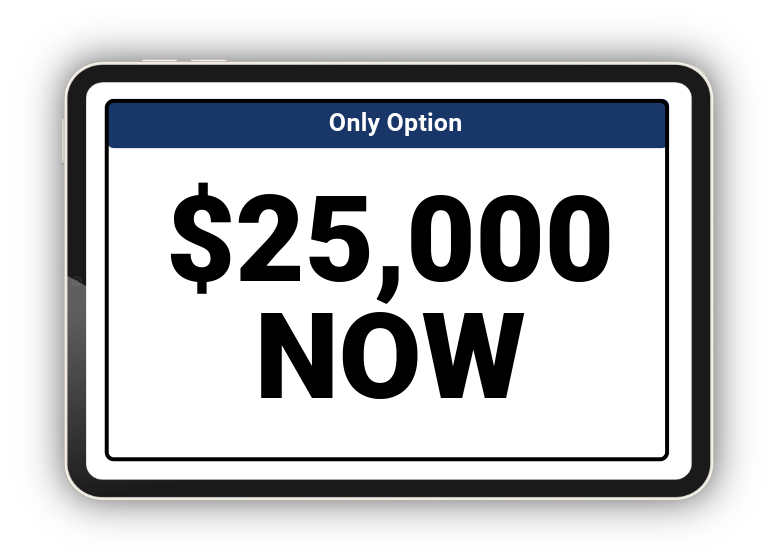
When a homeowner sees multiple payment options, their brain does different things:
- It compares the options to each other, not to other companies’ prices
- It finds the option that fits their situation (Good/Better/Best, or Cash/Finance/Promotional)
It focuses on what they’re getting for the money, not just the cost s the entire experience.
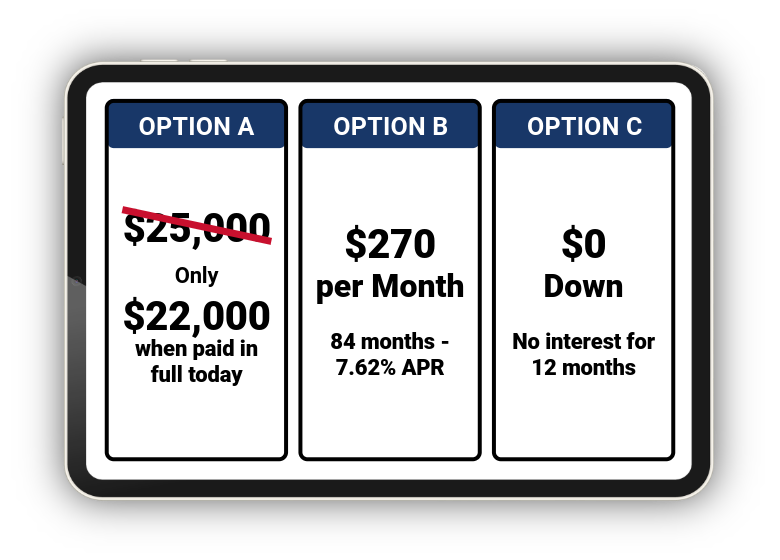
Common Types of Home Improvement Financing Options
Option 1: Paid-in-Full Offer – Cash Price with Discount
“Pay today, save $X”
This appeals to customers who have savings set aside or can liquidate funds. It’s also psychologically powerful because it frames the cash option as getting a deal, not just “paying the full price.”
Example: $25,000 cash price (saves $2,000 vs. financing)
Option 2: Monthly Payment Plan
This is where most homeowners feel comfortable. They want to spread the cost over time, typically 5-7 years (60-84 months).
It is important to present this option clearly. Estimates should include:
- Total project cost
- Monthly payment
- Interest rate and APR
- Total interest paid over the term
Many homeowners will choose this option because it’s familiar and fits into their current budget. A $25,000 project at 10.99% APR over 84 months is about $390/month which is easier to swallow than paying $25,000 upfront.
Option 3: Promotional or Special Financing with Deferred Interest or Low APR
“$0 Down, No Interest for 12 Months” or “No Payments Until Spring.”
These promotional offers are powerful because they lower the barrier to saying yes right now. They address the homeowner’s concerns by eliminating the immediate financial commitment.
Promotional financing also drives larger project sizes. When a homeowner sees “no interest for 12 months,” they’re more likely to add premium products because the financing feels manageable.
Presenting Home Improvement Financing to Customers
Here’s where the magic happens: showing all payment options on the same page, side-by-side.
The homeowner can see:

Option A: Cash savings, but requires $25,000 today

Option B: Spread payments out, $390/month, manageable

Option C: $0 down, payments start in January
They’re no longer comparing your quote to competitors’ quotes. They’re comparing your financing options to each other. And all three options represent ways they could move forward with your company.
It’s a psychological shift from “Can I afford this?” to “Which option works best for us?”
Transparency in Pricing Throughout the Sales Process Breaks Down Final Objections
Outlining the following early in the process can help customers trust you and feel comfortable with the cost of the project:
- Material cost
- Labor cost
- Financing fee (if applicable)
- Your profit
When pricing feels hidden or manipulated, they doubt you.
Transparent pricing says: “We’re not hiding anything. We’re confident in our value.” This builds trust, which closes deals.
For more information about the importance of transparency in home improvement estimating, visit our blog Why Transparency Matters in Home Improvement Quoting & Estimates or watch the webinar, Adapting to Buyer Expectations.

What Your Team Gains
Contractors who implement flexible financing see:
- Higher close rates. Multiple options mean more people find a path forward.
- Larger average tickets. When financing is easy and transparent, homeowners upgrade to premium options.
- Faster decision-making. Clear options accelerate the buying process.
- Fewer price objections. When pricing is transparent and options are presented clearly, objections are minimized.
- Stronger customer satisfaction. Homeowners who choose their own payment option feel more empowered and less pressured.
Making Financing an Enablement Tool, Not an Afterthought
The shift requires:
- Partner with multiple financing sources. Don’t rely on one lender. Offer options like banks, credit unions, buy-now-pay-later, and in-house financing.
- Train your team. Make sure every rep understands how to present financing as a benefit, not an apology.
- Build it into your proposal. Financing should be part of every quote you generate, not something you mention if asked.
- Use visual tools. Show financing options on screen or in print, side-by-side, with clear numbers.
- Test promotional offers. Experiment with different promotional rates and terms to see what drives decisions.“
Price Conditioning: Justifying Premium Options
This is an advanced technique that separates top performers from average contractors: price conditioning.
Instead of just presenting the price, you help the homeowner understand the value over time.
Example:
“The premium window option costs $500 more per window. But it has a 25-year warranty vs. 10 years for the standard option. Over 25 years, the cost per year is actually lower. Plus, it’ll increase your home’s resale value by roughly $2,000-$3,000, so you’re actually recovering your investment through home value appreciation.”
The $500 premium doesn’t feel like an upsell. It feels like a smart financial choice.
Price conditioning takes the focus off the sticker price and puts it on long-term value. It also justifies larger project sizes and premium options.
The Bottom Line
Financing isn’t just a way for customers to pay. It’s a sales tool. It’s how you remove barriers, enable bigger projects, and close more deals.
That 74% statistic of financing being a determining factor for homeowners when choosing a contractor isn’t an anomaly. It reflects the reality of the market: financing options influence buyer decisions more than nearly anything else.
If you’re not presenting flexible financing options, you’re leaving significant revenue on the table.
Looking for the right tool to showcase flexible financing options? Learn more about Paradigm Finance.
Sources:
Latest News

Stop Selling, Start Coaching: Consultative Selling for Contractors
Consultative selling helps home improvement contractors replace pushy pitches with trusted advice that improves close rates and reviews.
How Flexible Financing Removes Barriers in Home Improvement Projects
Flexible financing removes payment barriers. See how home improvement financing helps contractors win more projects.

Why Transparency Matters in Home Improvement Quoting & Estimates
Clear home improvement estimates lead to happier clients and fewer disputes. See why transparent home improvement quoting matters.