
Key Features to Look for in Contractor Software
Published: May 14, 2026
Read time: 5 minutes
Author: Paradigm

It’s no secret that in-home selling is complex. Teams are trying to manage leads, appointments, estimates, financing, contracts, and follow-up across multiple spreadsheets, CRMs, and disconnected apps. Contractors do not need more software. They need the right software.
When a sales team has the right tools in hand, they move faster, quote more accurately, and follow up more consistently, thereby creating a better buying experience for the customer. The right contractor software is not only an operations tool. It is a revenue tool.
Common Mistakes to Avoid When Choosing Contractor Software
We all know that you get what you pay for but don’t focus on price alone. Low-cost tools can look attractive up front, but they often create more manual work later. The opposite can happen as well. Buying a bloated platform full of features the team will never use doesn’t work either.
Integration is another common blind spot. If the software does not connect to the rest of your workflow, it becomes a data re-entry bottleneck where information can fall through the cracks. Team workflow integration is another point. If the software doesn’t support the reps in a way they see valuable, adoption will suffer.
There is also a long-term risk in choosing unsupported software that may not keep pace with your business. Sales processes change, financing changes, and product offerings change. If the platform cannot evolve with you, the “solution” eventually becomes another problem.
What to Look for in Your Contractor Software Platform
1. Lead Management & Pipeline Visibility

Contractor software should help your team capture leads from multiple sources and organize them in one place. That includes website forms, phone calls, referrals, paid ads, and other channels that feed the sales pipeline.
It should also make the pipeline easy to see. Strong visibility by stage, rep, and job type gives managers a clearer picture of forecasting and gives reps a clearer view of what needs attention next. Automated routing helps too, especially for businesses balancing territories, lead sources, or different service lines.
2. Appointment Scheduling & Calendar Integration
Scheduling should not be a manual task. The best contractor software helps teams book consultations in real time, sync with common calendar systems, and send reminders automatically so fewer appointments fall through.
This matters because every missed or delayed appointment affects close rate. For field teams, territory-aware scheduling is especially important. The fewer steps it takes to get the appointment on the calendar, the easier it is to keep the sales process moving.
3. Mobile-Friendly Contractor Sales App for Field Reps

If the software does not work well in the home, it does the sales team no good. A strong contractor app should give reps access to estimates, presentations, notes, and customer information from a tablet or mobile device.
That includes the ability to capture details on-site, such as measurements, notes, and photos. Offline functionality can matter too for remote locations or inconsistent connectivity. In-home sales is about speed and professionalism. Reps need tools that support both.
4. Estimating & Proposal Generation
Estimating is one of the most important parts of the contractor sales process, and one of the easiest places to lose momentum. The right software should help reps build quotes quickly with pre-built templates, dynamic pricing, and product configuration tools that reduce mistakes.
It should also support better presentation of choices. Good-better-best options can help with upselling, and polished proposals help build trust. A quote is not only a number, it is part of the close.
5. Integrated Financing Options
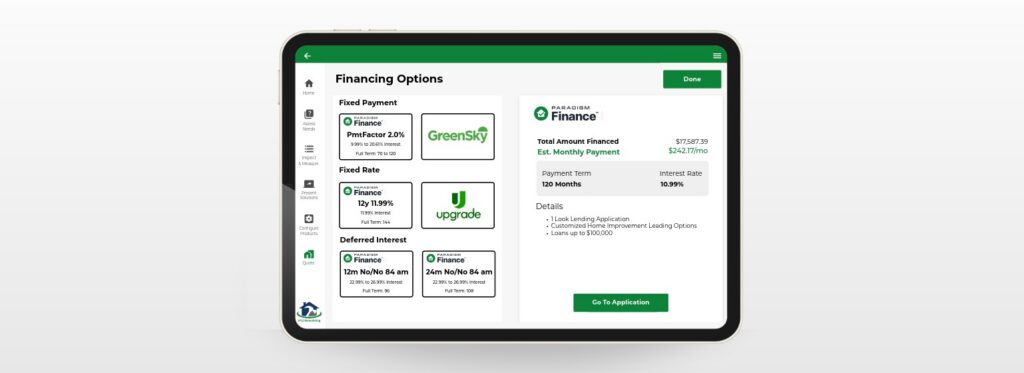
For many contractors, financing is a core part of how customers say “Yes!”. Contractor software should make it easy to present financing options during the sales process, ideally with pre-qualification or approval support followed by access to multiple lending options.
This matters because financing can directly influence both close rate and average ticket size. When it is built into the workflow, the customer experience feels smoother and the rep can guide the conversation more confidently.
6. Digital Contracts & eSignatures
Once the customer is ready to move forward, the software should make it easy to turn the proposal into a contract and capture a signature quickly. Built-in eSignature functionality reduces paperwork, speeds up closure, and keeps the process moving while the customer is still engaged.
It also helps with consistency. Digital contracts are easier to store, easier to track, and easier to reference later when questions come up.
7. CRM Functionality Built for Contractors
Generic CRM tools can manage contacts, but contractor sales requires more context than a standard contact record. Teams need visibility into project history, communications, notes, preferences, and where the customer is in the process from sale to completion.
Follow-up reminders and automation matter here, too. Many deals are won or lost after the first appointment, so the software should help teams stay organized without relying on memory alone.
8. Reporting & Sales Analytics

Contractor software should make it easier to see what is happening inside the sales process. Metrics like close rate, average deal size, and sales cycle length help leaders understand where the team is performing well and where coaching is needed.
Forecasting matters, too. Better reporting helps businesses make better hiring, marketing, and sales decisions. Data does not replace judgment, but it gives judgment something stronger to work from.
9. Integration with Other Business Systems
Sales software should connect to accounting tools, lead sources, and project management or production systems. This way, information moves cleanly from one stage to the next.
A connected tech stack reduces double entry, limits manual mistakes, and creates a more stable workflow. That matters more as the business grows and teams become more specialized.
10. Automation & Workflow Management
The best contractor software reduces repetitive work. Automated follow-ups, reminders, task creation, and status updates help the team stay on top of the process without relying on constant manual coordination.
That is valuable across departments too. Sales-to-production handoffs are cleaner when the system carries information forward instead of requiring people to rebuild it.
11. Customization & Scalability
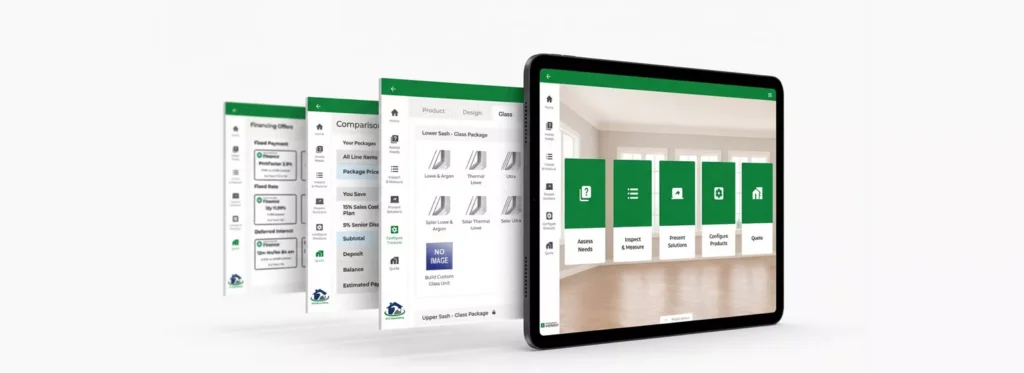
Contractors in roofing, windows, remodeling, HVAC, and other trades do not all sell the same way. The software should be flexible enough to support different workflows, pricing structures, and field requirements without forcing every business into the same mold.
That flexibility matters over time. The platform should be able to grow with the business, not cap it. Rigid systems tend to create workarounds, and workarounds usually create new problems.
12. User Experience & Ease of Adoption
Complicated software often fails for a simple reason: the team stops using it. Contractor software needs to be intuitive enough that reps can adopt it quickly and use it confidently in front of customers.
Ease of use is not just a “nice to have.” It is one of the strongest predictors of whether the platform will improve the sales process or become another system that sits off to the side.
13. Customer Experience Enhancements
Good contractor software not only supports the operational and sales workflow, it also improves the customer experience. Clean proposals, transparent pricing, clear next steps, and strong communication all reduce friction in the buying process.
Customers are not only evaluating the work. They are evaluating the experience of buying it. Software that helps create a clearer, more consistent experience can strengthen trust before the project even begins.
Choose Software That Drives Revenue Growth

The right contractor software should do more than help reps sell better. It should make the entire organization stronger.
When choosing a solution that’s right for your team, focus on prioritizing usability, integration, and return on investment over hype. The strongest platform is not the one with the longest feature list but the one that supports how your team actually sells.
Learn More about
Paradigm Vendo
Our software brings estimating, quoting, financing, contracts, and in-home sales tools into one workflow. Help your team move faster, present more professionally, and close with more confidence by scheduling a demo today.
"*" indicates required fields
Latest News
Benefits of Window and Door Estimating Software: Faster Quotes, Fewer Errors, More Sales
Still creating estimates manually? Learn how window and door estimating software can boost sales, improve accuracy, and help your business scale faster.

Clarity Converts: Lessons from Two Fast-Growing Dealers
Explore how fast-growing window and door dealers use clarity, process, and customer experience to support stronger sales and sustainable growth.

Win the Sale with Real-Time Manufacturer Sync
Stop losing bids to outdated pricing. Real-time manufacturer sync in your contractor estimating software helps you close more sales, faster.